
Across Davos 2026, discussions around global payments shifted noticeably from experimentation to execution, with payments and financial infrastructure emerging as areas of structural change. A common theme emerged across sessions: real-world payment systems are being re-designed to function in real time, with liquidity, compliance, and execution tightly integrated at scale.
Within this shift, PayFi has emerged as a payments-first financial paradigm, purpose-built to meet the demands of real-time, global money movement. Rather than treating payments as a downstream function, PayFi reframes liquidity, compliance, and execution as native components of the payment flow itself. This framing reflects a broader industry consensus: neither traditional finance nor decentralized finance alone can deliver the end-to-end infrastructure that modern global payments now require.
This report distills the key takeaways reflecting this broader evolution in global payments architecture, as PayFi—a finance and execution layer co-developed by Arf and its partners—takes shape in practice.
1. PayFi emerges as the new financial layer for global payments
A growing consensus throughout the week was the need to rethink global payment infrastructure from first principles. Existing financial stacks continue to struggle with real-time, cross-border, and programmable payments at scale, while global treasury models remain fragmented and capital-inefficient.
Treating liquidity, compliance, and settlement as separate layers has historically introduced capital inefficiencies, operational friction, and scalability constraints—most acutely in cross-border payment flows. As payment systems move toward real-time execution, these functions are increasingly converging directly around the payment event itself.
Within this context, PayFi takes shape as an execution layer for global payments—built natively on blockchain and digital assets, while integrating banking APIs, payment networks, compliance systems, and real-world financial infrastructure. At its core, PayFi re-designs financial products, liquidity services, treasury functions, and compliance frameworks through a payments-first lens.
By combining the regulatory strength, institutional trust, and scale of TradFi with the programmability and instant settlement capabilities of DeFi, PayFi forms a unified, institutional-grade stack purpose-built for payments. Rather than replacing existing systems, it operates as a coordination layer across them—allowing payment flows to be orchestrated dynamically across corridors, optimized for capital efficiency, and executed in real time.
The PayFi stack: a programmable model purpose-built for global payments
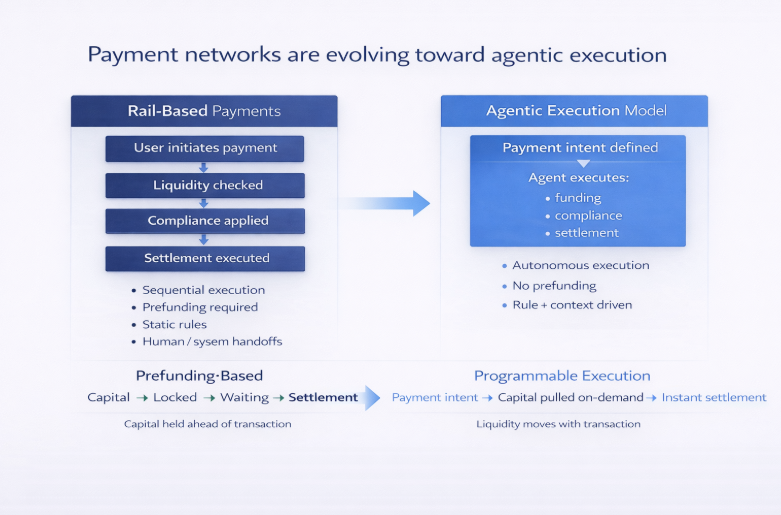
Traditional payment systems rely on sequential, vertically separated layers—where liquidity, compliance, and settlement operate independently. This creates capital inefficiencies and operational friction at scale.
PayFi aligns these functions within a single programmable flow. By coordinating funding, rules, and execution at the transaction level, it enables real-time payment finality while preserving institutional-grade controls and regulatory integrity.
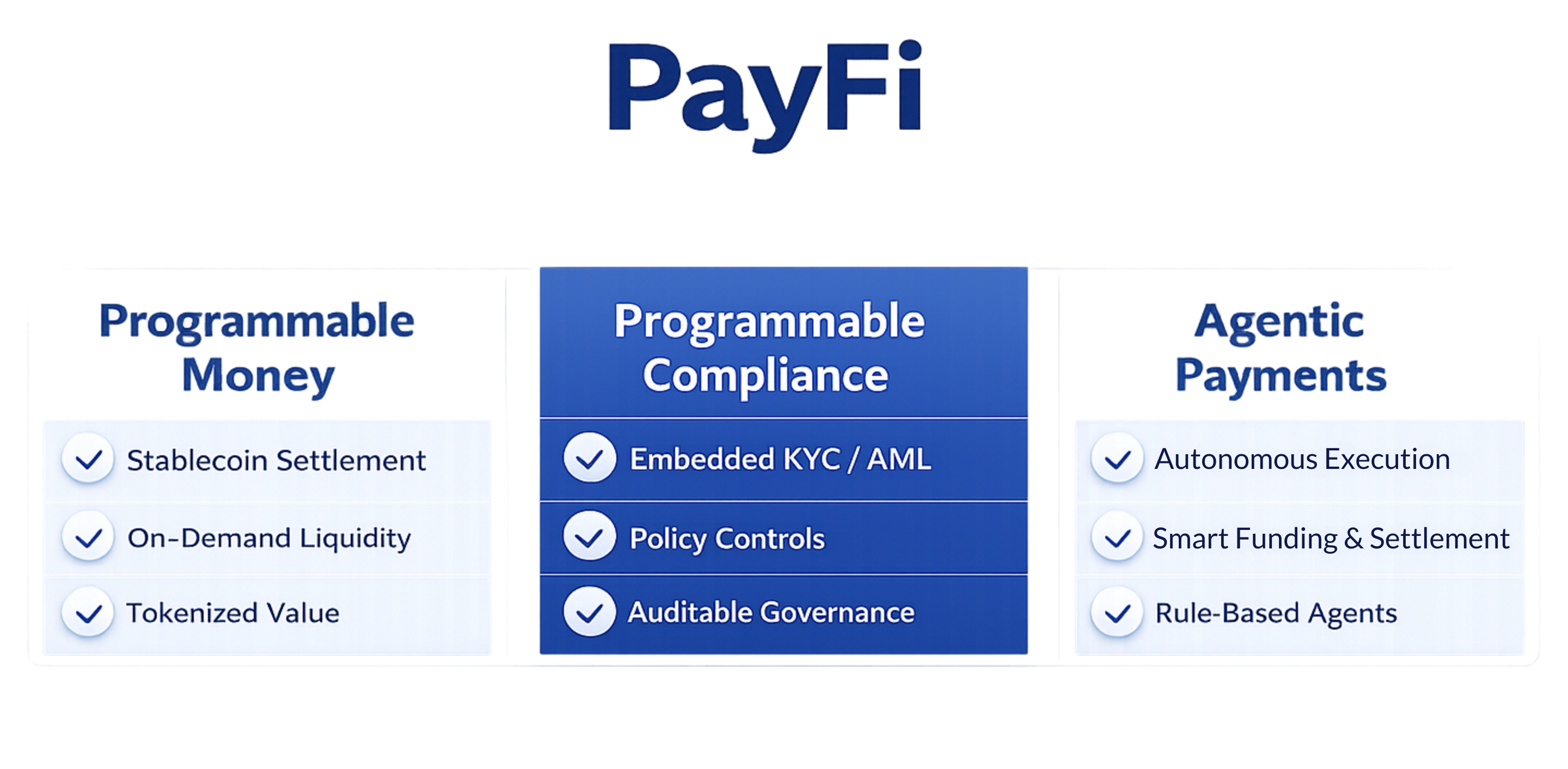
The PayFi stack is structured around three integrated pillars:
- Programmable Money enables liquidity to move dynamically with each transaction, removing the need for prefunding and idle capital.
- Programmable Compliance embeds governance, controls, and auditability directly into payment flows, ensuring regulatory alignment without manual intervention.
- Agentic Payments introduce autonomous execution, allowing transactions to initiate, fund, and settle themselves based on predefined rules and real-time conditions.
Together, these pillars form a cohesive, payment-native stack designed for institutional-scale adoption.
2. Programmable liquidity and compliance are live in real-world payment networks
Programmable liquidity and compliance are no longer emerging capabilities. They are now operating inside real payment networks, enabling on-demand funding, real-time settlement, and materially improved capital efficiency across cross-border flows. Rather than relying on prefunding or fragmented treasury structures, liquidity can now be triggered at the moment of payment itself, aligned with embedded compliance and settlement logic.
This shift reflects a broader rethinking of how payment infrastructure is designed. Liquidity, governance, and execution are no longer treated as separate operational layers, but as coordinated components of one continuous payment lifecycle. This allows payment networks to scale into new corridors faster, reduce idle capital, and operate with greater transparency, without compromising regulatory requirements.
Live proof: Arf and LuLu Financial Holdings operating programmable liquidity and compliance
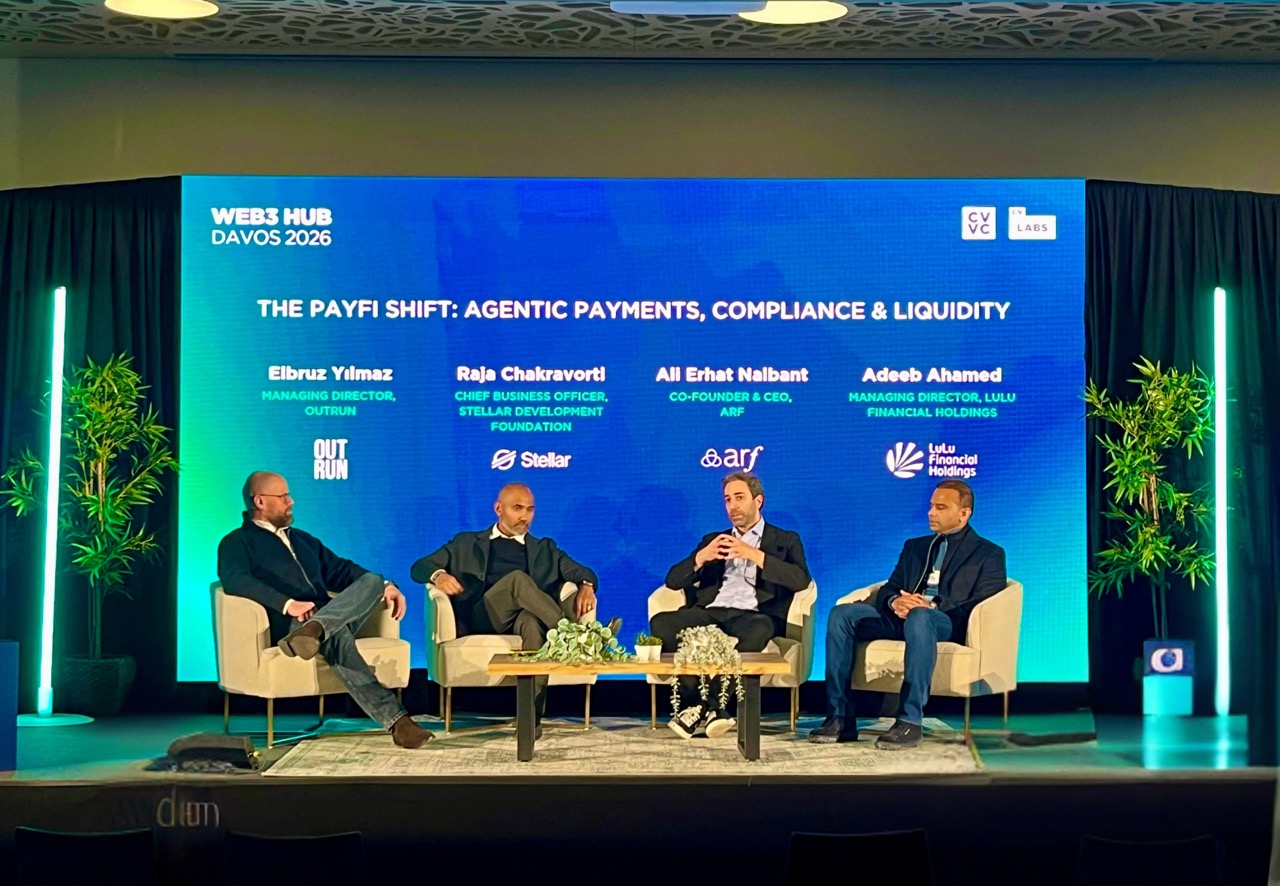
One of the most tangible real-world PayFi use cases discussed at Davos was the collaboration between Arf and LuLu Financial Holdings at Web3 Hub Davos, where programmable, on-demand liquidity is embedded directly into live payment flows. Through Arf’s regulated infrastructure, receivables-backed liquidity is triggered at the moment of transaction, enabling real-time settlement without prefunding or idle capital.
This model demonstrates how programmable liquidity and compliance can function natively within an institutional-grade, real-world payment network. Together, these implementations provide tangible proof that PayFi principles are operating at scale today.
3. Stablecoins are now foundational to global payment flows, forming the backbone of PayFi
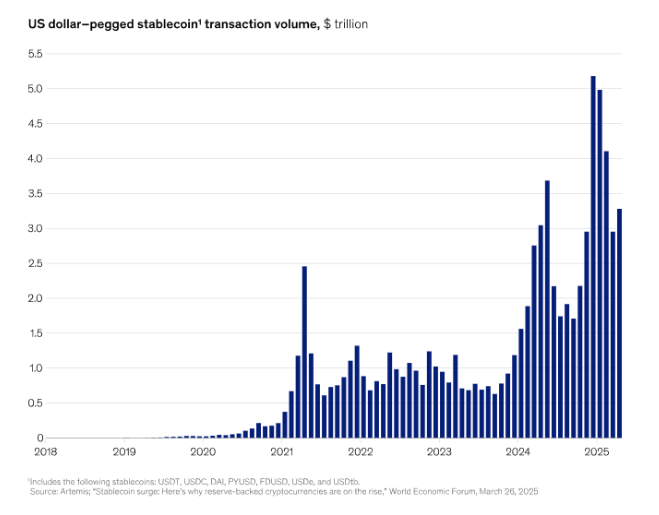
Stablecoins were consistently discussed at Davos not as an emerging technology, but as the consensus infrastructure choice for modern payments. Their ability to support real-time settlement and continuous movement of value positions them as a backbone of PayFi.
Unlike traditional payment rails that operate within banking hours and settlement windows, stablecoins function continuously. This always-on liquidity model is critical for PayFi's programmable architecture, where payment execution, funding, and settlement must coordinate in real time without manual intervention or timing dependencies. As institutions accelerate on-chain adoption, stablecoins are increasingly embedded directly into payment flows—enabling programmable payment logic at global scale across corridors, currencies, and networks.
Regulatory and institutional validation is reinforcing stablecoin adoption
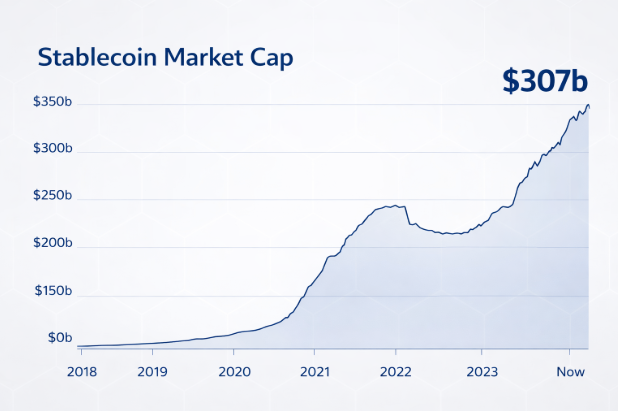
Recent regulatory and market developments are accelerating institutional-level stablecoin adoption. Initiatives such as the GENIUS Act point toward clearer federal frameworks governing stablecoin issuance, custody, and their role within regulated payment systems, reducing uncertainty for banks and regulated payment institutions. Market signals further reinforce this momentum. Total stablecoin market capitalization has surpassed $300 billion1, reflecting sustained real-world adoption.
Major financial institutions are now integrating stablecoins into treasury operations, cross-border payment corridors, and settlement infrastructure—signaling a shift from pilot programs to production-scale deployment.
4. Payment networks are evolving toward agentic ecosystems
Discussions across Davos pointed to a clear next phase for global payments: networks that do more than process transactions, but actively execute them. In agentic models, payments can initiate, fund, and settle themselves based on predefined rules and real-time parameters. This shift moves payments away from rigid, sequential rails toward intelligent networks capable of autonomous, end-to-end orchestration at scale.
This shift begins with moving away from prefunding-based models, where capital must be locked in advance to enable same-day settlement. As payment infrastructure becomes more programmable, liquidity, rules, and execution can be coordinated dynamically at the moment of payment rather than pre-positioned across corridors.
Agentic ecosystems extend this model further by enabling payments to act on intent and context, coordinating funding, compliance, and settlement as a single, automated flow. The result is a more capital-efficient and responsive payment network designed for global scale.
Agent-native payments are gaining industry-wide validation
This shift toward agentic payments is being reinforced by broader industry initiatives. The launch of Google’s Agent Payments Protocol (AP2) reflects growing momentum toward agent-native payment models, where software agents are authorized to initiate and complete transactions on behalf of users under explicit mandates.
By defining standardized frameworks for intent, authorization, and execution across both traditional and digital payment rails, AP2 validates that agent-driven payments are moving from concept to coordinated industry direction. Together with the trends discussed across Davos, this signals that agentic ecosystems are becoming a foundational design principle for next-generation payment networks.
Conclusion
Davos 2026 highlighted a clear structural shift in global payments. What was once debated as future architecture is now visible in production systems, market adoption, and regulatory alignment. Liquidity, compliance, and execution are no longer designed as separate concerns, but as coordinated components of a unified PayFi stack.
The evidence is now concrete: programmable liquidity is live in institutional payment corridors, stablecoins have crossed $300B in market capitalization with regulatory frameworks emerging, and agentic payment models are being standardized by major technology providers. PayFi is no longer a conceptual framework—it is the foundation for the next generation of global payments. For payment providers, banks, and financial institutions, the strategic question has shifted from whether to how fast to adopt PayFi principles. The organizations moving earliest into programmable infrastructure, stablecoin integration, and agentic execution are positioning themselves to capture the efficiency gains and competitive advantages that define the next era of global payments.
- https://defillama.com/stablecoins (January 2026) ↩︎