Arf is bringing RLUSD-powered settlement liquidity to licensed cross-border payment companies on the XRP Ledger (XRPL). Arf helped pioneer PayFi (payment finance) and has scaled to around $10 billion annually in global settlement volumes. As XRPL's native lending infrastructure comes online, it will become part of that settlement liquidity.
Cross-border payments move trillions of dollars every year, but the licensed companies moving that money face a fundamental challenge: working capital – specifically, settlement liquidity. Payment, credit card and remittance companies processing billions in transactions need significant amounts of working capital available across markets to pre-fund payment flows. Payment companies need that working capital available to fund transactions while they wait for payments to settle.
Traditional financing does not always match the speed of modern payments. Bank credit lines can take months to establish and typically require significant collateral — a poor fit for global payment companies, whose capital needs to move across markets rather than sit pledged in one. And for global payments, it is not whether you have the working capital or not in general, but where and when you have it.
What is PayFi?
PayFi, or payment finance, rethinks financial products through a payments lens, building treasury, FX, custody and investment products around real-time payment flows and the time value of money. It spans areas including settlement liquidity, receivables financing and treasury management between fiat and stablecoins. Arf and Huma Finance pioneered the category, with Arf providing the regulated infrastructure for PayFi and Huma transforming that regulated activity into one of the fastest-growing yield assets onchain.
For the public blockchain, XRPL, the focus is settlement liquidity, PayFi’s largest use case today. Arf and Ripple are bringing Arf’s settlement liquidity to XRPL, using RLUSD to provide short-duration working capital that is deployed and repaid as cross-border payments settle. Since launching in November 2022, Arf has scaled to $10 billion annually in global settlement volumes, with capital turning over 4x monthly. Headquartered in Zug, Switzerland, Arf is a Swiss-regulated financial institution and member of VQF, combining the fiat and stablecoin treasury management infrastructure of a regulated financial institution with Web3-native capabilities. Arf sits between both worlds: a regulated institution operating natively onchain, powered by real payment volume from traditional payment companies.
“Payment companies need capital to keep money moving while they wait for funds to settle. We’re meeting that need at scale, with $10 billion in annual settlement volume and capital turning over four times a month. Through this partnership with Ripple, we’re bringing stablecoin working capital to the XRP Ledger to help payment companies bridge that gap and support more payment volume.”– Ali Erhat Nalbant, Co-founder and CEO at Arf
“Settlement liquidity is exactly the kind of use case XRPL and RLUSD are built to support. Payment companies need fast access to capital across borders, without tying up significant amounts of liquidity. XRPL provides fast, efficient settlement, while RLUSD provides a regulated dollar stablecoin. Arf brings deep experience in PayFi, helping companies access short-term capital to keep payments moving while they wait for funds to settle.”– Jasmine Cooper, Head of Product for RippleX at Ripple
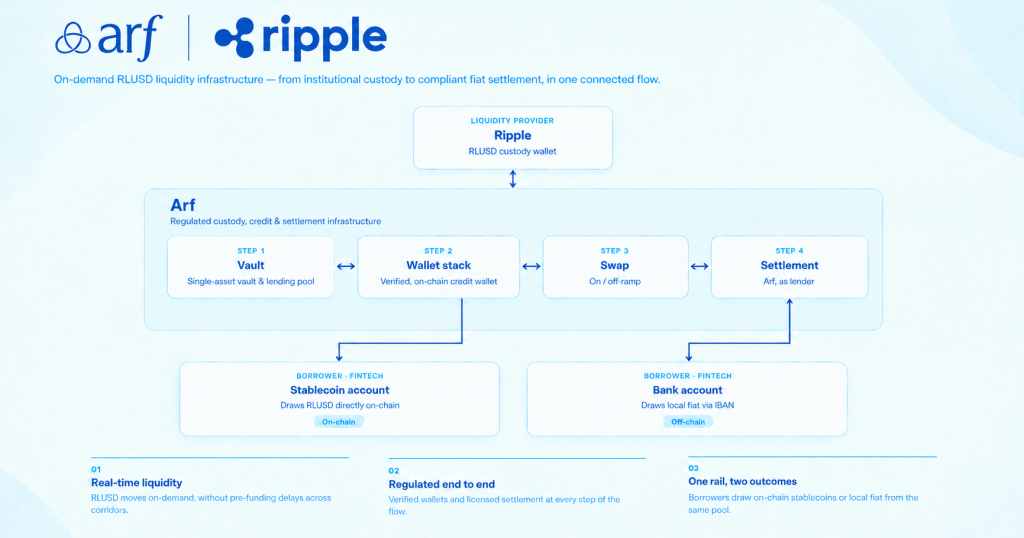
As the first phase of the partnership, Arf will provide direct RLUSD settlement liquidity on the XRP Ledger. Arf’s short-duration settlement liquidity is typically repaid within one to five days as cross-border payments settle, allowing capital to be repeatedly deployed against real payment flows.
Native Lending on the XRPL
Once XRPL’s native lending infrastructure becomes available, Arf plans to bring more of its settlement liquidity activity directly onto the protocol. That means the capital supporting this liquidity can be managed onchain and deployed through native lending functionality, while Arf continues to handle underwriting and working capital decisions offchain.
The infrastructure includes Single Asset Vaults, which allow capital to be pooled and managed onchain, and the Lending Protocol, which enables that capital to be extended as structured loans. The proposed capabilities are subject to XRPL’s amendment process before they can become available on mainnet.
Payment companies do not need to operate onchain to benefit. Arf allows licensed financial institutions to manage their treasuries between fiat and stablecoins, supported by Arf’s bank accounts in major financial hubs, while the underlying blockchain infrastructure operates behind the scenes.
Arf has already built against the proposed protocol, providing a concrete implementation of how the Lending Protocol can support institutional settlement financing.
What This Means for XRPL, RLUSD, and XRP
Together, the program creates a new source of revolving settlement liquidity on XRPL, with RLUSD powering the credit flows and XRP supporting the underlying network activity.
XRPL gains revolving, real-world lending activity tied to settlement liquidity. Arf’s short-duration model means capital can be deployed, repaid and redeployed repeatedly rather than sitting in one-time transactions. At scale, this project offers a tangible example of how XRPL’s native lending infrastructure can support fintech credit.
RLUSD becomes the asset used across these credit flows, from loan disbursement through repayment. That further distributes RLUSD into real working capital use cases for licensed payment companies operating across global payment corridors, while the revolving nature of the loans allows the same liquidity to support repeated working capital activity.
XRP supports the underlying network activity. Transactions on XRPL require fees paid in XRP, while accounts and certain ledger objects carry XRP reserve requirements. As lending activity grows, it creates additional recurring use of the ledger and its native asset alongside RLUSD-denominated working capital.
What's Next
Arf will continue serving as a design partner, providing implementation feedback as the Single Asset Vault and Lending Protocol specifications progress toward activation.
Once the XRPL Lending Protocol amendments (XLS-65 and XLS-66) activate on mainnet, Arf plans to transition the program to the native protocol infrastructure.